The postcard arrived on a Tuesday, the kind of ordinary day that never expects anything life changing to ring its doorbell. It was tucked among coupon flyers and a glossy catalog, the quietest thing in my mailbox, yet the only one that made my fingers slow down. The front showed a red lighthouse shouldering a restless sky, seagulls like commas in the wind. The back said, in tidy blue ink, For when you are ready to come home. It was addressed to Eleanor Finch at my apartment number, with a Harbor Point postmark and no return address.
I live above a florist and a shoe repair, in a brick building that looks like it sighs when it rains. My mail usually knows me by now. I am a columnist who writes about everyday tenderness and the way ordinary objects collect meaning the way windows collect light. So I stood there in my hallway, flowers breathing through the floorboards, and thought about how a rectangle of cardstock had just invited itself into my life with the confidence of a long lost friend.
There are a hundred reasonable things to do with a misdelivered postcard. You can hand it back to the post office. You can drop it on the foyer table and let it become part of the building’s anonymous pile. You can even keep it and let the mystery soften into decoration. But Tuesdays are for making unreasonable choices. I slipped the postcard into my tote and decided to find Eleanor Finch.
At the post office, the fan above the line hummed like a polite old uncle. Mr. Russo, who knows everyone and calls me by my column name, tilted his head when I explained.
Wrong addressee, he said, but right address. Could be a previous tenant. Could be someone put the wrong number down. We can return it to sender, except there is no sender. He looked again. Harbor Point. My sister takes her kids to the lighthouse every summer. If you want a clue, check the community noticeboard. People pin up everything there. Lost cats, guitar lessons, the history society lecture on Victorian ice houses. He winked. Maybe an Eleanor looking for herself.
The noticeboard looked like the inside of a very social beehive. There were tear off tabs for piano tuning, a flyer for a blood drive, a photo of a golden retriever wearing a bandanna that said Finn. I was staring at a hand drawn map of Harbor Point when someone beside me said, Do you like postcards, or are you trying not to like them as much as I try not to buy secondhand books.
He was tall with kind eyes and a denim shirt rolled at the sleeves, holding a stack of freshly printed postcards advertising a student writing showcase at a local bookshop called Second Story. He smiled at my confusion and added, I teach history over at the high school and I moonlight as a part time bookstore optimist. We are doing a display of letters and postcards from the town archives next month. That lighthouse is on half of them. I am Noah.
I was suddenly aware of the way my heart does a small dance when a conversation is about to become a story. I am June, I said. And I might be trying not to like postcards because one just asked me to find its home. I showed him the card, the red lighthouse, the blue words that felt like a hand on my shoulder.
Noah glanced at the handwriting, then leaned closer, and I noticed the soap clean smell of someone who began the day with good intentions. Three neat loops in the F of Finch. The writer learned cursive in the eighties, he said, soft as if not to scare the letters. Or from someone who learned from someone who did. A teacher thing. Sorry. May I.
He studied it, then looked up. Harbor Point is an hour away. If you want to find this Eleanor, we could start at the town records. Or at the lighthouse museum. Unless you are the kind of person who does not enjoy adventures with strangers from noticeboards.
That depends on the stranger, I said, and surprised myself by saying yes.
We made a date to meet at Second Story that Saturday. The bookshop sits on a corner where the light stalls in the afternoons like an old friend who cannot quite say goodbye. The bell chimed when I walked in, the sound born to make a person hope. Noah looked up from behind the counter where a cardboard box of letters sat like a treasure chest.
I pulled us two coffees from the little machine we keep for emergencies, he said, and I decided that it was extremely considerate to treat the search for a stranger like something that deserved caffeine and comfort. We spread the letters out on a table tucked between history and poetry. He told me about his students and how he uses postcards as writing prompts. What does home look like to you today. What does it smell like. How does it sound at midnight.
I told him that home used to be an apartment across town where the bookshelves were hung slightly crooked and the kitchen smelled like burned toast. I told him that I had left that home when a love story became more about furniture than feelings. I told him that I moved into this apartment above the florist and started writing about resilience because I needed to remind myself that I had some.
For when you are ready to come home, Noah repeated, as if testing how the words felt in his mouth. Have you considered that the postcard might be meant for you.
I smiled but shook my head. It is not my name on the front. But I think the message is for whoever needs it most. Maybe that is the trick of postcards. They travel farther than we aim them, and still land where they are supposed to.
On Saturday we drove to Harbor Point in his old blue car that had a map pocket stuffed with maps. The road curved through fields and then dipped toward the water. The lighthouse grew from a thumb sized promise into a solid white tower with a red cap, the way a hope becomes a plan. We walked up the path where the wind braided itself through our hair. At the museum gift shop, a woman with hair the color of sea glass looked up from her knitting.
Looking for stories or souvenirs, she asked. Here you can buy both.
We set the postcard on the counter. The woman held it as if it had a pulse.
Eleanor Finch, she said slowly. I have not said that name out loud in years. I am Mabel. Eleanor used to run the artists co op by the marina. There are still watercolors of that lighthouse in local kitchens because of her. She lived in the city for a spell when she was young. I think your address might have been her address long ago. She paused and then smiled at a memory. Jack Randall used to send her postcards whenever she got spooked about coming back to town. He would write, For when you are ready to come home. He wrote it so often it became a promise more than a sentence.
Do you know what happened, I asked. Did she come back.
Mabel nodded. One Sunday she arrived with a suitcase and sunburned shoulders and never left again. They married under the lighthouse. She died a few years back, and Jack before her. But the co op still runs. There is a bench with their names down by the marina. Sometimes people sit there when they are trying to make up their minds. Especially about leaving or staying.
We thanked her and walked to the bench, which faced the water and the sky as if it were a theater and the clouds were actors who took their time. Someone had left a little stack of blank postcards between the slats. Noah picked one up and looked at me. Write something, he said. Even if you never mail it.
I thought of all the ways a heart can take its time. I wrote, Dear June, you are allowed to want more and less at the same time. More of what steadies you, less of what needs explaining. Then, as if my hand had its own agenda, I added, Dear Noah, tell me your definition of home.
He read over my shoulder and laughed low. I used to think home was a place where you know where the spoons are, he said. Now I think it is a person who looks at you like you are both a map and a destination.
We stayed until the gulls’ shadows stretched long. On the drive back we talked about the ways fear dresses up as practicality. He told me he had been offered a yearlong fellowship in Chicago. It was the kind of opportunity that looks good on paper and keeps future doors open. I told him I was happy for him. My voice wobbled the way hard truths wobble before they steady.
It is not for sure, he said. I have not decided.
I tried to practice detachment, the way yoga instructors tell you to release a thought like a balloon. The trouble is that some thoughts come back and land on your shoulder. On Sunday we walked through the farmers market. He held a basket. I held a peach we did not need. We talked about his students, my column, the postcard exhibit he wanted to plan. He was the kind of person who connected dots that other people did not see, and I realized I had been missing that in my life. Not just affection, but attention. The listening kind.
A week later I stopped by Second Story to drop off a vase of daisies for the checkout counter and maybe a piece of my pride. Noah was on the floor, building a little display of vintage postcards under glass. He looked up with that expression that reminds you that you are expected and welcome. Our exhibit is in three weeks, he said. Would you consider writing the wall text about why people send postcards in a world where you can text a photo in five seconds.
Because a postcard is slow and slowness is a love language, I said without thinking.
That is your opening line, he said, and grinned.
The following days were a gentle avalanche. We met for coffee and wrote at opposite corners of a table, then slid our notebooks toward each other like shy confessions. We took long walks at dusk and learned the geography of our differences. He liked the morning. I liked the late afternoon. He read biographies. I read novels about quiet revolutions. But we agreed on the important things. The way a kitchen feels bigger when two people wash dishes together. The holiness of old songs on new speakers. The relief of being misread, then corrected, then forgiven.
When the fellowship email finally arrived, he did not tell me. I found out by accident, the way people in small towns accidentally discover everything. I had stopped at the cafe near the bookstore and the barista who knew everyone’s business and gave it back with a side of cinnamon said, Congratulations to your friend on Chicago. Big news. I stood there with my cup like a prop I had not rehearsed, and realized that my heart had made up its mind without telling me first.
I walked to the marina and sat on a bench that did not have our names on it. The water was a practiced comfort. Sometimes it is easier to sit with a body of water than with your own body. I thought about all the leaving I had done. Apartments, plans, a man I once believed was my last chapter. I thought about the postcard and the line that had traveled through time like a faithful dog. For when you are ready to come home. Maybe home was not a ZIP code. Maybe it was a decision to stop running from your own longing.
I sent Noah a text. Meet me at the lighthouse. He replied with a thumbs up and a heart. I told myself not to read the symbols like tea leaves. When he arrived, breath warm in the salt air, I said, If you go, I will be happy for you and I will miss you and I will send you postcards with too many words. If you stay, I will be happy for you and I will miss the person you would have been in that city. Either way I will not be brave and silent at the same time. I will pick one and it will be brave.
He looked at the water, then at me. I thought I needed to leave to prove something to myself, he said. Maybe I needed to stay to prove something else. That I can build the life I want without outsourcing the courage to a new skyline. He took my hand, a gesture that felt both brand new and ancient. I told the fellowship no this morning. I did not tell you because I was afraid that if I spoke it out loud and you looked disappointed, I would crumble a little, and then I would have to pretend that I did not. He squeezed my hand. I do not want to leave this, he said quietly. I do not want to leave you.
There is a difference between a happy ending and a true beginning. A happy ending is confetti. A true beginning is a grocery list with two handwriting styles and a key on the hook by the door. In the weeks that followed, we opened the postcard exhibit. People came with their pockets full of small stories. Someone pinned up a card from a soldier to his sister promising her a dance. Someone else brought one from a grandmother who wrote from a train with coffee that tasted like stars. We placed the lighthouse postcard under glass, with a note that said Found in the right mailbox at the right time.
I wrote my column about how objects live in our homes the way ideas live in our heads, and how both can be rearranged when we allow it. Readers wrote back with their own messages they had not known were meant for them until the day they arrived. One said she had forgiven her brother. Another said he had signed up for the night class he kept promising himself he would take. Bravery breeds bravery, and suddenly the town felt full of people turning small rectangles of paper into large acts of love.
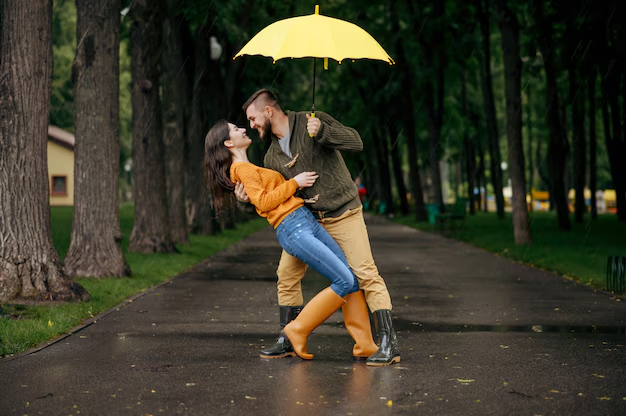
On a rainy afternoon in October, Noah walked into my apartment with an umbrella that drip dripped like a patient metronome and a postcard he had bought from the museum gift shop. The front showed the lighthouse under a storm sky. The back had his careful print. For when you are ready to come home, he had written, and then below it, even if home turns out to be me, even if home turns out to be us.
I put it on my fridge with a magnet shaped like a pear. It looked so ordinary there among the grocery rewards coupons and the dry cleaner receipt. That is the thing about the moments that change everything. They do not always arrive with trumpets. Sometimes they walk in quietly and hang their coat in the hallway and ask what you want for dinner. Sometimes they are a sentence on the back of a postcard that finds you because you finally remembered to look up.
When I pass the noticeboard at the post office now, I look for love the way birdwatchers look for rare wings. I see it. In the guitar lessons tab with only one tear off left. In the dog named Finn who was found. In the lecture on Victorian ice houses where two strangers might sit side by side and agree that history is simply what happens when people do their best and leave proof. I think about Eleanor and Jack and the bench by the marina that still holds a spot for indecision. I think about how coming home can be a place, or a person, or a self you are finally ready to inhabit.
Last week, we drove back to Harbor Point and stood under the lighthouse at dusk. The keeper was closing up, the gulls were making up their minds. The sky put on its quilt of soft colors. Noah stood behind me and wrapped his arms around my shoulders in a way that made my lungs remember to relax. We did not say anything for a while. Words are my trade, but silence is my side job. When the light flickered on, it painted a path across the water and then kept repainting it, as if to say here, and here, and still here. I felt something rearrange inside me, a drawer that had been stuck for years pulling open on smooth runners.
It turns out that a postcard can change everything because it reminds you that you have a choice. To chase the big life or to build the good one. To keep waiting for the perfect moment or to send the message now. To believe that home is behind you, or to trust that it is also ahead, waiting to be lived into. I slid my hand into Noah’s and thought about what I would write on the next postcard we sent, even if it was addressed to the same street where we already live. Wish you were here, we could say, and mean it about ourselves. We are here. We are home. We are ready.